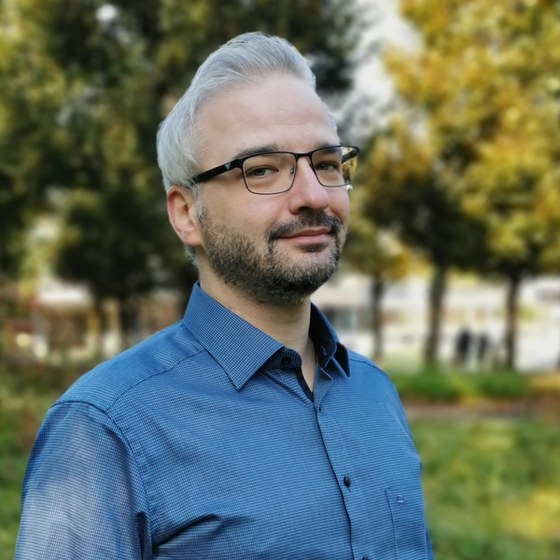
Paul Jerabek
Group Leader Computational Materials Design
Deputy Head of Department of Materials Design
Helmholtz-Zentrum Hereon, Max-Planck-Straße 1, 21502 Geesthacht
Education
Dr. rer. nat.
Philipps-Universität Marburg, Marburg
Thesis: Clusterartige und hochkoordinierte Metallkomplexe (grade: excellent)
Supervisor: Prof. Dr. Gernot Frenking
Dipl.-Chem.
Philipps-Universität Marburg, Marburg
Thesis: Bindungstheoretische Untersuchungen der Systeme des Typs YE-X-EY (grade: very good)
Supervisor: Prof. Dr. Gernot Frenking
Studies of Chemistry
Philipps-Universität Marburg, Marburg
Professional experience
Deputy Head of Department of Materials Design
Helmholtz-Zentrum Hereon, Geesthacht
Department administration and representation, third-party funding acquisition, research strategy planning, digital transformation.
Co-Leader, German-New Zealand Green Hydrogen Centre (He Honoka Hauwai)
Helmholtz-Zentrum Hereon / University of Otago, Geesthacht / Dunedin
Administration and representation, strategic planning, networking, funding acquisition, event organization.
Group Leader “Metal Hydride Modeling”
Helmholtz-Zentrum Hereon, Geesthacht
First-principles molecular dynamics, CALPHAD and phase-field simulations for the characterization and optimization of novel metal hydride materials for large-scale hydrogen storage. Close collaborations with Lawrence Livermore National Laboratory (USA) and the University of Otago (New Zealand).
Humboldt Return Fellow
Max-Planck-Institut für Kohlenforschung, Mülheim an der Ruhr
Theoretical investigation of physical properties of oganesson; substituent and solvent effects on switching temperature in Fe(II) spin-crossover complexes; reaction mechanism exploration for asymmetrical, homogeneous catalysis; bonding situation and electronic properties of pincer complexes.
Postdoctoral Research Assistant
Massey University, Auckland
Monte-Carlo melting simulations of heavy and superheavy elements; first-principles molecular dynamics simulations of coinage metals in liquid and solid phase; highly accurate calculations of atomic polarizabilities.
Feodor Lynen Research Fellow
Massey University, Auckland
Photochemistry of small molecules in different environments; influence of relativistic and solvent effects on atomic and molecular bonding properties; development of highly accurate ab-initio many-body potentials for heavy and superheavy elements.
Postdoctoral Research Assistant
Philipps-Universität Marburg, Marburg
Method development (C) for core electron spectroscopy of organic molecules on surfaces; density functional theory based investigation of transition metal clusters and complexes.
Research Assistant
Philipps-Universität Marburg, Marburg
Quantum chemical investigation of main-group and transition metal compounds in collaboration with experimental groups in Bochum, München, Göttingen, Dresden, Münster and San Diego. Redesign of the lab course in Theoretical Chemistry.
Student Assistant
Philipps-Universität Marburg, Marburg
Supervision of lab courses in Physical Chemistry and Chemistry for Medical Students.
Third-party funding
Sustainable TiFe Generation from Secondary Sources
BMBF (Germany) · Principal Investigator · 1.5 M€ · 3 years
HIDA Visiting Researcher Grant (with S. Faouri)
Helmholtz Association · Host · 10 k€ · 2 months
HIDA Visiting Researcher Grant (with A. Rowberg)
Helmholtz Association · Host · 15 k€ · 3 months
Generating Hydrogen Storage Materials from New Zealand Resources
BMBF (Germany) · Coordinator · 400 k€ · 3 years
Establishing a German-New Zealand Research Centre for Green Hydrogen
BMBF (Germany) · Coordinator · 760 k€ · 5 years
HIDA Visiting Scientist Grant (with M. Selzer)
Helmholtz Association · Fellow · 10 k€ · 3 months
Humboldt Return Fellowship
Alexander von Humboldt Foundation · Fellow · 47 k€ · 1 year
Computation of highly accurate interatomic potentials of heavy and superheavy elements
New Zealand eScience Infrastructure (NeSI) · Principal Investigator · 117 k€ · 1.5 years
Hochpräzise quantenchemische Simulationen von atomaren und molekularen Phasen unter extremen Bedingungen
Alexander von Humboldt Foundation · Fellow · 85 k€ · 2 years
Conference organization
E-MRS Fall Meeting 2025 — Symposium A
Co-organizer · Warsaw · Poland
E-MRS Fall Meeting 2024 — Symposium C: Sustainable materials for chemical and electrochemical energy storage II
Main organizer · Warsaw · Poland
4 days, 165 participants. Held at Technical University Warsaw.
Inaugural New Zealand Hydrogen Symposium
Co-organizer · Dunedin · New Zealand
3 days, 200 participants.
Bonding Analysis Workshop
Conceptualization and main organizer · Marburg · Germany
5 days, 70 international participants.
Teaching
Hydrogen Technology
Co-lecturer · Technische Universität Hamburg (TUHH) · Hamburg
Knowledge for Tomorrow – Cooperative Research Projects in Sub-Saharan Africa (Volkswagen-Stiftung)
Tutor · University of Mauritius · Reduit
Lectureship
Lecturer · Technische Hochschule Mittelhessen · Gießen
Hands-on workshops on electronic structure methods
Workshop lecturer · Various universities · Hyderabad, Dunedin, Denton, Mariapfarr, Mauritius
Practical course in Theoretical Chemistry
Teaching assistant · Philipps-Universität Marburg · Marburg
Physical Chemistry and Chemistry for Medical Students
Student assistant · Philipps-Universität Marburg · Marburg
Skills and languages
German (native), English (business-fluent), Czech (second native language)
Linux (expert, CLI and HPC environment), Windows
ORCA, ADF, Gaussian, Molpro, Turbomole, DIRAC, VASP
Bash, Python (very skilled); Fortran, C (experienced)
LaTeX, GNUplot, Avogadro, Chemcraft, VMD, Jmol, Inkscape, Microsoft/LibreOffice
Quantum chemical methods
Coupled cluster, perturbation theory, CASSCF, NEVPT2, ADC, EOM-CCSD, GGAs, hybrids, meta-GGAs, TDDFT
Electronic structure calculations, structure prediction (molecular and solid-state), reaction enthalpies
Spectroscopic properties (IR, UV/VIS, NMR, X-ray absorption), catalytic and photochemical reaction pathways, solvent effects, relativistic effects (scalar and spin-orbit)
Monte-Carlo and molecular dynamics simulations, energy decomposition analysis (EDA), ELF, QTAIM, NBO, ESP
Reviewing activities
- Journal of the American Chemical Society
- Chemical Communications
- Inorganic Chemistry
- Journal of Computational Chemistry
- Organometallics
- ChemPhysChem
- Physical Chemistry Chemical Physics
- Molecular Physics
- New Journal of Chemistry
- Chemistry - An Asian Journal
- International Journal of Quantum Chemistry
- Zeitschrift für Anorganische und Allgemeine Chemie
Professional memberships
- Gesellschaft Deutscher Chemiker e.V. (GDCh)
- Alexander von Humboldt Alumni Network
Mentoring and supervision
- PhD student supervision in the Department of Materials Design at Hereon
- Mentoring of undergraduate and graduate students in the work groups of Prof. Frenking (8), Prof. Berger (2) and Prof. Schwerdtfeger (4)
Outreach
- Co-founder of the online video channel Chymiatrie: over 120 online videos on a variety of chemical topics, from experiments to interviews
- Experiment demonstrator at the “Open Day for High-school Students” at Massey University, Auckland
Talks and posters
- Contributed Talk: 8
- Invited Seminar: 14
- Invited Talk: 6
- Poster: 10
- Workshop Lecture: 5
Peer-reviewed journal articles
70 articles.
Ni–Cr Substitution in TiFe: An Integrated Experimental–Modeling Study of Phase Stability and Hydride Thermodynamics
E. Pericoli, V. Ferretti, E. Alvares, P. Jerabek, C. Pistidda, L. Pasquini
Adv. Energy Sustain. Res. 2026, 7, e70243.
Relativistic effects are crucial for uranium-phosphorus bonding: a DFT study of cyclopentadienyluranium-phosphine complexes
J.-E. Ahrens, P. Jerabek, L. Vondung
Mol. Phys. 2026, e2611400.
Role of Elemental Substitution on Hydrogen Incorporation in Characteristic Ti/Fe-Based Oxides
A. J. E. Rowberg, S. Kang, K. Sellschopp, P. Jerabek, T. W. Heo, B. C. Wood
ACS Appl. Energy Mater. 2026, 9, 1242–1253.
Leveraging atomic disorder to modulate hydrogen storage thermodynamics in compositionally complex intermetallics
Y. Shang, A. Santhosh, P. Jerabek, T. Klassen, C. Pistidda
Interdiscip. Mater. 2026, 1-13.
Predicting hydrogen storage capacity loss of FeTi by ab initio thermodynamic modelling of Fe–Ti–Si phase equilibria
L. Dinachandran, E. Alvares, K. Sellschopp, T. Klassen, P. Jerabek, A. L. Garden
Acta Mater. 2025, 301, 121514.
TiAlNb alloy interatomic potentials: comparing passive and active machine learning techniques with MTP and DeePMD
A. Chandran, A. Santhosh, P. Jerabek, R. C. Aydin, C. J. Cyron
Front. Mater. 2025, 12.
Low-temperature regeneration of metal hydride after impurity gas exposure
Y. Shang, A. Santhosh, M. Ante, L. Wimbert, P. Jerabek, T. Schupp, T. Klassen, C. Pistidda
Acta Mater. 2025, 298, 121398.
High Ionic Conduction in Rb- and Cs-Mixed Cation Amide for Energy Storage
T. T. Le, K. Sellschopp, F. Murgia, A. L. Garden, S. Bordignon, J. P. Embs, M. R. Chierotti, A. Schökel, F. Karimi, P. Jerabek, T. Klassen, C. Pistidda
Small 2025, 2502943.
A Thermodynamic Approach to Model Multicomponent FeTi-based Alloys for Hydrogen Storage
E. Alvares, A. J. E. Rowberg, K. Sellschopp, B. C. Wood, T. Klassen, P. Jerabek, C. Pistidda
Scr. Mater. 2025, 259, 116516.
Multiscale modeling of metal-hydride interphases—quantification of decoupled chemo-mechanical energies
E. Alvares, K. Sellschopp, B. Wang, S. Kang, T. Klassen, T. W. Heo, T. Klassen, P. Jerabek, C. Pistidda
npj Comput. Mater. 2024, 10, 249.
Comparative analysis of ternary TiAlNb interatomic potentials: moment tensor vs. deep learning approaches
A. Chandran, A. Santhosh, C. Pistidda, P. Jerabek, R. Aydin, C. J. Cyron
Front. Mater. 2024, 11, 1466793.
Thermodynamic assessment of the Ce-H and CeNi5-H system
P. Hannappel, E. Alvares, F. Heubner, C. Pistidda, P. Jerabek, T. Weißgärber
Calphad 2024, 85, 102701.
Predictable electronic tuning of FeII and RuII complexes via choice of azine: correlation of ligand pKa with Epa(MIII/II) of complex
M. Robb, L. Bondi, S. Rodriguez‐Jimenez, A. Garden, P. Jerabek, S. Brooker
Dalton Trans. 2024, 53, 1999-2007.
Tipping the balance between the bcc and fcc phase within the alkali and coinage metal groups
A. Robles-Navarro, P. Jerabek, P. Schwerdtfeger
Angew. Chem. Int. Ed. 2024, 63, e202313679.
First-principles study on interfacial property in MgB2-based reactive hydride composites
Y. Shang, A. Santhosh, P. Jerabek, T. Klassen, C. Pistidda
Scr. Mater. 2024, 240, 115837.
Low-Cost, Multifunctional, and Sustainable Sodium Sulfido Ferrate(II)
M. Ghazanfari, K. Siemensmeyer, A. Santhosh, J. Vrijmoed, M. Tallu, S. Dehnen, P. Jerabek, G. Thiele
Inorg. Chem. 2023, 62, 15358-15366.
Ultra-lightweight compositionally complex alloys with large ambient-temperature hydrogen storage capacity
Y. Shang, Z. Lei, E Alvares, S. Garroni, R. Dore, M. Rustici, S. Enzo, A. Schökel, Y. Shi, P. Jerabek, Z. Lu, T. Klassen, C. Pistidda
Mater. Today 2023, 67, 113-126.
Influence of near-surface oxide layers on TiFe hydrogenation - Mechanistic insights and implications for hydrogen storage applications
A. Santhosh, S. Kang, N. Keilbart, B. C. Wood, T. Klassen, P. Jerabek, M. Dornheim
J. Mater. Chem. A 2023, 11, 18776-18789.
Experimental and Computational Studies on the Formation of Mixed Amide-Hydride Solid Solutions for CsNH2-CsH System
T.-T. Le, A. Santhosh, S. Bordignon, M. R. Chierotti, P. Jerabek, T. Klassen, C. Pistidda
Results in Engineering 2023, 17, 100895.
Magnesium- and intermetallic alloys-based hydrides for energy storage: modelling, synthesis and properties
L. Pasquini, K. Sakaki, E. Akiba, P. Jerabek et al.
Prog. Energy 2022, 4, 32007.
Relativistic Effects Stabilize Unusual Gold(II) Sulfate Structure via Aurophilic Interactions
P. Jerabek, A. Santhosh, P. Schwerdtfeger
Inorg. Chem. 2022, 61, 13077-13084.
Solving a problem with a single parameter: A smooth bcc to fcc phase transition for metallic lithium
P. Jerabek, A. Burrows, P. Schwerdtfeger
Chem. Commun. 2022, 58, 13369-13372.
Remarkable Infrared Nonlinear Optical, Dielectric, and Strong Diamagnetic Characteristics of Semiconducting K3[BiS3]
M. R. Ghazanfari, L. Vittadello, D. Al-Sabbagh, A. Santhosh, C. Frankcom, F. Fuß, C. A. von Randow, K. Siemensmeyer, J. C. Vrijmoed, F. Emmerling, P. Jerabek, M. Imlau, G. Thiele
J. Phys. Chem. Lett. 2022, 13, 6987–6993.
Large-scale synthesis of mixed valance K3[Fe2S4] with high dielectric and ferrimagnetic characteristics
M. R. Ghazanfari, A. Santhosh, J. C. Vrijmoed, K. Siemensmeyer, B. Peters, S. Dehnen, P. Jerabek, G. Thiele
RSC Adv. 2022, 12, 30514–30521.
Large Exchange Bias, High Dielectric Constant, and Outstanding Ionic Conductivity in a Single-Phase Spin Glass
M. R. Ghazanfari, A. Santhosh, K. Siemensmeyer, F. Fuß, L. Staab, J. C. Vrijmoed, B. Peters, M. Liesegang, S. Dehnen, O. Oeckler, P. Jerabek, G. Thiele
Adv. Electron. Mater. 2022, 8, 2200483.
From the gas phase to the solid state: The chemical bonding in the superheavy element flerovium
E. Florez, O. R. Smits, J.-M. Mewes, P. Jerabek, P. Schwerdtfeger
J. Chem. Phys. 2022, 157, 64304.
An Effective Activation Method for Industrially Produced TiFeMn Powder for Hydrogen Storage
D. M. Dreistadt, L. Thi-Thu, G. Capurso, J. M. Bellosta von Colbe, A. Santhosh, C. Pistidda, N. Scharnagl, H. Ovri, C. Milanese, P. Jerabek, T. Klassen, J. Jepsen
J. Alloys Compd. 2022, 919, 165847.
Quantitative assessment of ligand substituent effects on σ- and π-contributions to Fe-N bonds in spin crossover FeII complexes
L. Bondì, A. L. Garden, F. Totti, P. Jerabek, S. Brooker
Chem. Eur. J. 2022, 28, e202104314.
Modeling the thermodynamics of the FeTi hydrogenation under para-equilibrium: An ab-initio and experimental study
E. Alvares, P. Jerabek, Y. Shang, A. Santhosh, C. Pistidda, T. W. Heo, B. Sundman, M. Dornheim
Calphad 2022, 77, 102426.
Hydrogenation via a low energy mechanochemical approach: The MgB2 case
C. Pistidda, A. Santhosh, P. Jerabek, Y. Shang, A. Girella, C. Milanese, M. Dore, S. Garroni, S. Bordignon, M. R. Chierotti, T. Klassen, M. Dornheim
J. Phys. Energy 2021, 3, 44001.
Oganesson: A Noble Gas Element That Is Neither Noble Nor a Gas
O. R. Smits, J. Mewes, P. Jerabek, P. Schwerdtfeger
Angew. Chem. Int. Ed. 2020, 59, 23636–23640.
First-principles melting of krypton and xenon based on many-body relativistic coupled-cluster interaction potentials
O. R. Smits, P. Jerabek, E. Pahl, P. Schwerdtfeger
Phys. Rev. B 2020, 101, 104103.
Catalytic Asymmetric Fluorination of Copper Carbene Complexes: Preparative Advances and a Mechanistic Rationale
M. Buchsteiner, L. Martinez‐Rodriguez, P. Jerabek, I. Pozo, M. Patzer, N. Nöthling, C. W. Lehmann, A. Fürstner
Chem. Eur. J. 2020, 26, 2509–2515.
Quantitative and Chemically Intuitive Evaluation of the Nature of M−L Bonds in Paramagnetic Compounds: Application of EDA‐NOCV Theory to Spin Crossover Complexes
L. Bondì, A. L. Garden, P. Jerabek, F. Totti, S. Brooker
Chem. Eur. J. 2020, 26, 13677–13685.
Ligands Based on Phosphine-Stabilized Aluminum(I), Boron(I), and Carbon(0)
L. Vondung, P. Jerabek, R. Langer
Chem. Eur. J. 2019, 25, 3068–3076.
Oganesson Is a Semiconductor: On the Relativistic Band-Gap Narrowing in the Heaviest Noble-Gas Solids
J.-M. Mewes, P. Jerabek, O. R. Smits, P. Schwerdtfeger
Angew. Chem. Int. Ed. 2019, 58, 14260–14264.
Solid Oganesson via a Many-Body Interaction Expansion Based on Relativistic Coupled-Cluster Theory and from Plane-Wave Relativistic Density Functional Theory
P. Jerabek, O. R. Smits, J.-M. Mewes, K. A. Peterson, P. Schwerdtfeger
J. Phys. Chem. A 2019, 123, 4201–4211.
Dative and Electron-Sharing Bonding in Transition Metal Compounds
P. Jerabek, P. Schwerdtfeger, G. Frenking
J. Comput. Chem. 2019, 40, 247-264.
A Hundred-Year-Old Experiment Re-evaluated: Accurate Ab-Initio Monte-Carlo Simulations of the Melting of Radon
O. Smits, P. Jerabek, E. Pahl, P. Schwerdtfeger
Angew. Chem. Int. Ed. 2018, 57, 9961–9964.
The Light-Driven Isomerization of Aqueous Nitrate: A Theoretical Perspective
J.-M. Mewes, P. Jerabek, D. S. Bohle, P. Schwerdtfeger
ChemPhotoChem 2018, 2, 725–733.
Tipping the Balance between Ligand and Metal Protonation due to Relativistic Effects: Unusually High Proton Affinity in Gold(I) Pincer Complexes
P. Jerabek, L. Vondung, P. Schwerdtfeger
Chem. Eur. J. 2018, 24, 6047–6051.
A relativistic coupled-cluster interaction potential and rovibrational constants for the xenon dimer
P. Jerabek, O. Smits, E. Pahl, P. Schwerdtfeger
Mol. Phys. 2018, 116, 1–8.
Static dipole polarizability of palladium from relativistic coupled-cluster theory
P. Jerabek, P. Schwerdtfeger, J. K. Nagle
Phys. Rev. A 2018, 98, 12508.
Electron and nucleon localization functions of oganesson: Approaching the Thomas-Fermi limit
P. Jerabek, B. Schuetrumpf, P. Schwerdtfeger, W. Nazarewicz
Phys. Rev. Lett. 2018, 120, 53001.
Suppressed Phosphine Dissociation by Polarization Effects on the Donor–Acceptor Bonds in [Ni(PEt3)4–n (ECp*)n] (E = Al, Ga)
J. Hornung, J. Weßing, P. Jerabek, C. Gemel, A. Pöthig, G. Frenking, R. A. Fischer
Inorg. Chem. 2018, 57, 12657–12664.
Influence of Relativistic Effects on Bonding Modes in M(II) Dinuclear Complexes (M = Au, Ag, and Cu)
P. Jerabek, B. von der Esch, H. Schmidbaur, P. Schwerdtfeger
Inorg. Chem. 2017, 56, 14624–14631.
The Oxygen-Rich Beryllium Oxides BeO4 and BeO6
Q. Zhang, P. Jerabek, M. Chen, M. Zhou, G. Frenking
Angew. Chem. Int. Ed. 2016, 55, 10863–10867.
Understanding the F 1s NEXAFS Dichroism in Fluorinated Organic Semiconductors
M. Klues, P. Jerabek, T. Breuer, M. Oehzelt, K. Hermann, R. Berger, G. Witte
J. Phys. Chem. C 2016, 120, 12693–12705.
Zn...Zn interactions at nickel and palladium centers
K. Freitag, M. Molon, P. Jerabek, K. Dilchert, C. Rösler, R. W. Seidel, C. Gemel, G. Frenking, R. A. Fischer
Chem. Sci. 2016, 7, 6413–6421.
The σ-Aromatic Clusters [Zn3]+ and [Zn2Cu]: Embryonic Brass
K. Freitag, C. Gemel, P. Jerabek, M. I. Oppel, R. W. Seidel, G. Frenking, H. Banh, K. Dilchert, R. A. Fischer
Angew. Chem. Int. Ed. 2015, 54, 4370–4374.
Stepwise Synthesis of Siloxane-Substituted Oligoarsanes and Structural Investigation of Alkaline Earth Metal Derivatives
C. Clobes, P. Jerabek, I. Nußbruch, G. Frenking, C. von Hänisch
Eur. J. Inorg. Chem. 2015, 3264-3273.
Isolation of Neutral Mononuclear Copper Complexes Stabilized by Two Cyclic (Alkyl)(amino)carbenes
D. S. Weinberger, N. Amin SK, K. C. Mondal, M. Melaimi, G. Bertrand, A. C. Stückl, H. W. Roesky, B. Dittrich, S. Demeshko, B. Schwederski, W. Kaim, P. Jerabek, G. Frenking
J. Am. Chem. Soc. 2014, 136, 6235–6238.
A Novel Concept for the Synthesis of Multiply Doped Gold Clusters [(M@AunM’m)Lk]q+
A. Puls, P. Jerabek, W. Kurashige, M. Molon, T. Bollermann, M. Winter, C. Gemel, Y. Negishi, G. Frenking, R. A. Fischer
Angew. Chem. Int. Ed. 2014, 53, 4327–4331.
Experimental Charge Density Study of a Silylone
B. Niepötter, R. Herbst-Irmer, D. Kratzert, P. P. Samuel, K. C. Mondal, H. W. Roesky, P. Jerabek, G. Frenking, D. Stalke
Angew. Chem. Int. Ed. 2014, 53, 2766–2770.
Hume-Rothery Phase-Inspired Metal-Rich Molecules: Cluster Expansion of [Ni(ZnMe)6(ZnCp*)2] by Face Capping with Ni(0)(η(6)-toluene) and Ni(I)(η(5)-Cp*)
M. Molon, C. Gemel, P. Jerabek, L. Trombach, G. Frenking, R. A. Fischer
Inorg. Chem. 2014, 53, 10403–10411.
Coinage Metals Binding as Main Group Elements: Structure and Bonding of the Carbene Complexes [TM(cAAC)2] and [TM(cAAC)2]+ (TM = Cu, Ag, Au)
P. Jerabek, H. W. Roesky, G. Bertrand, G. Frenking
J. Am. Chem. Soc. 2014, 136, 17123–17135.
Comparative bonding analysis of N2 and P2 versus tetrahedral N4 and P4
P. Jerabek, G. Frenking
Theor. Chem. Acc. 2014, 133, 1447-1456.
Bonding analysis of telluroketones H2A=Te (A = C, Si, Ge)
N. B. Jaufeerally, P. Ramasami, P. Jerabek, G. Frenking
J. Mol. Mod. 2014, 20, 2433–2440.
Dizinc Cation [Zn2]2+ Trapped In A Homoleptic Metalloid Coordination Environment Stabilized by Dispersion Forces: [Zn2(GaCp*)6 ][BAr4F]2
K. Freitag, H. Banh, C. Gemel, P. Jerabek, G. Frenking, R. A. Fischer
Inorg. Chem. 2014, 54, 352-358.
Isolation of Neutral Mono- and Dinuclear Gold Complexes of Cyclic (Alkyl)(amino)carbenes
D. S. Weinberger, M. Melaimi, C. E. Moore, A. L. Rheingold, G. Frenking, P. Jerabek, G. Bertrand
Angew. Chem. Int. Ed. 2013, 52, 8964–8967.
The Organozinc Rich Compounds [Cp*M(ZnR)5] (M = Fe, Ru; R = Cp*, Me, Cl, Br)
M. Molon, C. Gemel, R. W. Seidel, P. Jerabek, G. Frenking, R. A. Fischer
Inorg. Chem. 2013, 52, 7152–7160.
Structures and energies of C4S4q (q=+1, 0, -1) isomers. A theoretical study
P. Jerabek, G. Frenking
Int. J. Mass. Spectrom. 2013, 354-355, 342–345.
[3+2] Fragmentation of an [RP5Cl]+ Cage Cation Induced by a N-Heterocyclic Carbene
M. H. Holthausen, S. K. Surmiak, P. Jerabek, G. Frenking, J. J. Weigand
Angew. Chem. Int. Ed. 2013, 52, 11078–11082.
Reductive elimination: A pathway to low-valent aluminium species
C. Ganesamoorthy, S. Loerke, C. Gemel, P. Jerabek, M. Winter, G. Frenking, R. A. Fischer
Chem. Commun. 2013, 49, 2858–2860.
Nearly Degenerate Isomers of C(BH)2 : Cumulene, Carbene, or Carbone?
S. R. Barua, W. D. Allen, E. Kraka, P. Jerabek, R. Sure, G. Frenking
Chem. Eur. J. 2013, 19, 15941–15954.
Hunting dimers
A. Yu. Rogachev, P. Jerabek, S. Klein, G. Frenking, R. Hoffmann
Theor. Chem. Acc. 2012, 131, 1-11.
Ligand-Stabilized [P(4)](2+) Cations
M. Donath, E. Conrad, P. Jerabek, G. Frenking, R. Fröhlich, N. Burford, J. J. Weigand
Angew. Chem. Int. Ed. 2012, 51, 2964–2967.
A crystalline singlet phosphinonitrene: a nitrogen atom-transfer agent
F. Dielmann, O. Back, M. Henry-Ellinger, P. Jerabek, G. Frenking, G. Bertrand
Science 2012, 337, 1526-1528.
Oligonuclear molecular models of intermetallic phases: a case study on [Pd2Zn6Ga2(Cp*)5(CH3)3]
T. Bollermann, M. Molon, C. Gemel, K. Freitag, R. W. Seidel, M. von Hopffgarten, P. Jerabek, G. Frenking, R. A. Fischer
Chem. Eur. J. 2012, 18, 4909–4915.
The Rich Chemistry of [Zn2Cp*2]: Trapping Three Different Types of Zinc Ligands in the PdZn7 Complex [Pd(ZnCp*)4(ZnMe)2{Zn(tmeda)}]
T. Bollermann, K. Freitag, C. Gemel, M. Molon, P. Jerabek, G. Frenking, R. A. Fischer
Inorg. Chem. 2011, 4, 10486–10492.