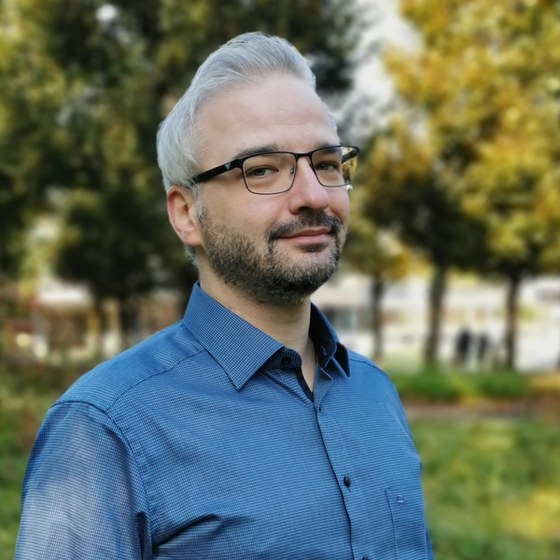
Paul Jerabek
Group Leader Computational Materials Design · Deputy Head of Department of Materials Design
Institute of Hydrogen Technology, Department of Materials Design · Helmholtz-Zentrum Hereon · Geesthacht
I develop multiscale simulation approaches for hydrogen storage materials. My group links density functional theory, CALPHAD thermodynamics and molecular dynamics to describe TiFe-based metal hydrides — from the electronic structure of an interstitial hydrogen site up to the phase behaviour of a full storage tank — always in close dialogue with experiment.
Before joining Hereon I worked on relativistic quantum chemistry with Peter Schwerdtfeger in Auckland and on chemical bonding theory with Gernot Frenking in Marburg. I co-lead the German–New Zealand Green Hydrogen Centre He Honoka Hauwai and serve as deputy head of the Department of Materials Design at the Institute of Hydrogen Technology.
Research
Using computer simulations to describe the material before it is made.
Metal hydrides materials for hydrogen storage
Effects of element substitution, description interfaces, thermodynamics and kinetics via DFT and AIMD/MD.
Multiscale simulations
Combining DFT, CALPHAD, MD and phase-field methodology to perform quantitative mesoscale simulations for microstructure evolution and (de)hydrogenation kinetics.
Relativistic quantum chemistry
Quantifying the relativistic effects of physics and chemistry of heavy and superheavy elements, from gold to oganesson, using post-HF methods, DFT, MD/MC.
AI-driven materials research
Machine-learned interatomic potentials and data-driven workflows accelerating the search for new hydrogen-storage and functional materials.
Chemical Bonding Analysis
Energy decomposition analysis and orbital-based bonding pictures explaining structure and reactivity trends, from carbene-stabilised complexes to the heaviest elements.
News
New paper in Adv. Energy Sustain. Res.: Ni–Cr Substitution in TiFe: An Integrated Experimental–Modeling Study of Phase Stability and Hydride Thermodynamics →
New paper in Mol. Phys.: Relativistic effects are crucial for uranium-phosphorus bonding: a DFT study of cyclopentadienyluranium-phosphine complexes →
New paper in ACS Appl. Energy Mater.: Role of Elemental Substitution on Hydrogen Incorporation in Characteristic Ti/Fe-Based Oxides →
New paper in Interdiscip. Mater.: Leveraging atomic disorder to modulate hydrogen storage thermodynamics in compositionally complex intermetallics →
Selected publications
Ni–Cr Substitution in TiFe: An Integrated Experimental–Modeling Study of Phase Stability and Hydride Thermodynamicsopen access
E. Pericoli, V. Ferretti, E. Alvares, P. Jerabek, C. Pistidda, L. Pasquini
Adv. Energy Sustain. Res. 2026, 7, e70243. · doi:10.1002/aesr.70243 ·
@article{Pericoli2026e,
  author   = {E. Pericoli and V. Ferretti and E. Alvares and P. Jerabek and C. Pistidda and L. Pasquini},
  title    = {{Ni–Cr Substitution in TiFe: An Integrated Experimental–Modeling Study of Phase Stability and Hydride Thermodynamics}},
  journal  = {Adv. Energy Sustain. Res.},
  year     = {2026},
  volume   = {7},
  pages    = {e70243},
  doi      = {10.1002/aesr.70243},
}Relativistic effects are crucial for uranium-phosphorus bonding: a DFT study of cyclopentadienyluranium-phosphine complexesopen access
J.-E. Ahrens, P. Jerabek, L. Vondung
Mol. Phys. 2026, e2611400. · doi:10.1080/00268976.2025.2611400 ·
@article{Ahrens2026a,
  author   = {J.-E. Ahrens and P. Jerabek and L. Vondung},
  title    = {{Relativistic effects are crucial for uranium-phosphorus bonding: a DFT study of cyclopentadienyluranium-phosphine complexes}},
  journal  = {Mol. Phys.},
  year     = {2026},
  pages    = {e2611400},
  doi      = {10.1080/00268976.2025.2611400},
}Role of Elemental Substitution on Hydrogen Incorporation in Characteristic Ti/Fe-Based Oxides
A. J. E. Rowberg, S. Kang, K. Sellschopp, P. Jerabek, T. W. Heo, B. C. Wood
ACS Appl. Energy Mater. 2026, 9, 1242–1253. · doi:10.1021/acsaem.5c03738 ·
@article{Rowberg2026c,
  author   = {A. J. E. Rowberg and S. Kang and K. Sellschopp and P. Jerabek and T. W. Heo and B. C. Wood},
  title    = {{Role of Elemental Substitution on Hydrogen Incorporation in Characteristic Ti/Fe-Based Oxides}},
  journal  = {ACS Appl. Energy Mater.},
  year     = {2026},
  volume   = {9},
  pages    = {1242–1253},
  doi      = {10.1021/acsaem.5c03738},
}Leveraging atomic disorder to modulate hydrogen storage thermodynamics in compositionally complex intermetallicsopen access
Y. Shang, A. Santhosh, P. Jerabek, T. Klassen, C. Pistidda
Interdiscip. Mater. 2026, 1-13. · doi:10.1002/idm2.70030 ·
@article{Shang2026b,
  author   = {Y. Shang and A. Santhosh and P. Jerabek and T. Klassen and C. Pistidda},
  title    = {{Leveraging atomic disorder to modulate hydrogen storage thermodynamics in compositionally complex intermetallics}},
  journal  = {Interdiscip. Mater.},
  year     = {2026},
  volume   = {0},
  pages    = {1-13},
  doi      = {10.1002/idm2.70030},
}From the structure gallery
All 42 structures →Current projects
HydridVault
A portable metal hydride demonstrator tank for safe, low-pressure hydrogen storage.
GreenH2Metals
Sustainable, circular metal alloys for the efficient and safe storage of hydrogen in stationary applications.
1.5 M€
He Honoka Hauwai
Bilateral German-New Zealand research centre for green hydrogen, jointly run by Hereon and the University of Otago.
760 k€